
Road authority
Determine whether the road is state-maintained, municipal, county-controlled in a limited context, or private. The road name and appearance alone may not establish who owns the entrance decision.
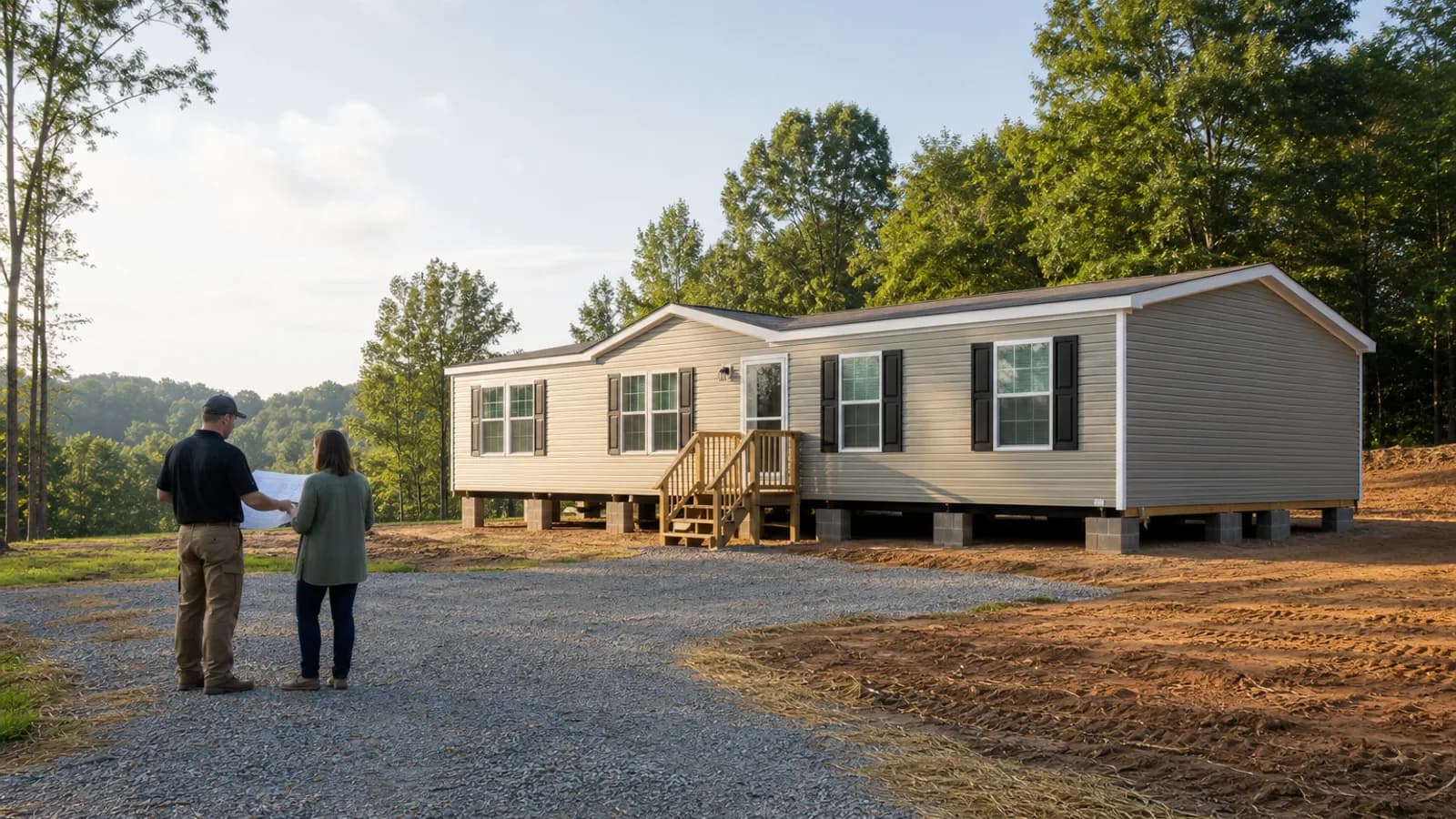
Road And Access
A car reaching the parcel does not prove the project has a usable entrance, legal access, or a practical mobile home delivery route. People also call it a trailer home and the county's paperwork says manufactured home; all three mean a home to live in, not a travel trailer or RV.
Short answer: Identify whether the road is state-maintained, municipal, or private using current official records, then gather the deed, plat, easement, private-road agreement, maintenance agreement, permissions, gates, bridge records, and delivery-use questions for qualified review. Road status, legal access, permission for construction traffic, entrance approval, and physical route feasibility are separate decisions; this page does not determine any of them.
Reviewed by a manufactured home setup contractor and dealer.
Buying land for a mobile home? The Land Check reads the county's own permit rules for the one parcel you give us, and says where each answer came from and when.
$125. Asking takes no payment and places no order.
Getting the home to the site
Schematic — not a survey
Looking down at the turn
Looking from the side at the entrance
Each of these is checked by a different person: the utility owns the line, the road authority owns the entrance, and only the transporter who will actually haul the home can say whether the route works. Reaching the parcel in a car answers none of them.
Start with the exact property, quote, record, or job detail behind your question. Mark what is confirmed, what still needs a current source, and who must answer it. Use the checklist to keep the next call, document, or decision clear.
Public road, state-maintained road, private road, easement, and shared driveway are different starting points.
Entrance approval and transport feasibility are separate questions handled by different people.
Access work can affect the site plan, culvert, grading, drainage, trees, delivery cost, and project sequence.
Step 1
Record the road name, maintenance authority, frontage, driveway location, deed or plat access language, gates, bridges, and visible constraints.
Step 2
Ask the road authority and local planning office which entrance, driveway, culvert, setback, address, or site-plan steps apply.
Step 3
Give the transporter current photos, measurements, route details, home dimensions, and site approach before treating delivery as workable.
Details to Sort
Determine whether the road is state-maintained, municipal, county-controlled in a limited context, or private. The road name and appearance alone may not establish who owns the entrance decision.
Search the NCDOT Public Street Information Database by location, record the displayed maintenance or ownership context and date, and follow up when the road is not highlighted or the result conflicts with local or recorded documents. The lookup does not establish private access rights, maintenance obligations, entrance approval, bridge capacity, or delivery feasibility.
Collect the deed, plat, easement, private-road agreement, road-maintenance agreement, amendments, gate or entry terms, shared-driveway documents, and any owner or association contacts. Ask who is responsible for ordinary maintenance, delivery-related damage, advance notice, temporary access, gates, bridges, culverts, restoration, and cost sharing, then send rights or enforceability questions to the appropriate legal or title professional.
Ask about driveway location, permit, sight distance, culvert, drainage, width, grade, setbacks, emergency access, address assignment, and how the entrance connects to the planned home site.
Review turns, shoulders, bridges, road width, slopes, gates, trees, wires, railroad crossings, soft ground, staging area, crane needs, and the path for each home section. Only the transporter can assess its delivery scope.
Ask whether a recorded or current agreement exists, which parcels and road segments it covers, who maintains the surface and drainage, whether notice or written permission is expected for oversized delivery, how temporary work or damage is handled, who controls gates or bridges, and which documents the transporter or insurer needs. This page does not interpret the agreement or establish access rights.
A mapped or recorded route may not be physically suitable, and a drivable route does not prove a legal right, maintenance obligation, delivery clearance, bridge capacity, driveway approval, or utility route. Put record, survey, legal, road-owner, transportation, and field-access questions on separate due-diligence tasks.
Keep the current deed, recorded plat, easement, subdivision street disclosure when applicable, road-maintenance agreement and amendments, association documents, owner contacts, road-status lookup, driveway records, bridge or gate information, route photos, and the transporter's written questions together. Record source, recording reference, date, covered parcel or segment, and unresolved limitation for each item.
A recorded access right, maintenance duty, road-owner consent, driveway approval, utility easement, oversized-delivery notice, temporary widening or trimming permission, bridge review, and transporter route acceptance are separate decisions. The responsible legal, public, private, and transport parties must answer their own questions.
List the public road, private road, shared drive, bridge, gate, apron, culvert, turnaround, and final site approach separately. For each segment, record the owner or authority, maintenance source, recorded right, permission question, driveway process, physical evidence, transporter review, unresolved limitation, and date checked.
A useful record identifies the exact segment, parcel, road name or number, source, authority or document, date, decision addressed, limitations, and next step. It should not turn a road lookup into a legal-access opinion, a driveway permit into route approval, or a transporter review into a bridge-capacity or engineering conclusion.
Record the road name, segment, parcel, lookup source and date, stated maintenance authority, deed, plat, easement, private-road and maintenance agreements, referenced instruments, owner or association contact, gates, bridge or culvert records, delivery notice requirements, damage and restoration terms, and unresolved questions. Do not summarize a document as granting delivery rights unless a qualified source responsible for that conclusion confirms it.
Manufactured Home Land Check
A Manufactured Home Land Check can organize road, entrance, recorded-access, bridge, site, and utility questions from current sources. It does not issue a legal or delivery conclusion.
Secondary Support
Tell us the work and your ZIP and we send you to the right contractor category page, where you send the request. No account needed.
Map frontage does not necessarily establish a permitted entrance, safe sight distance, private access rights, or a transport-ready approach.
Next step: Confirm the road authority, recorded access, and entrance process for the proposed driveway location.
The entrance may have unknown permit history, width, culvert, drainage, grade, ownership, maintenance, or delivery limitations.
Next step: Gather records and have the responsible authority and transporter review the current condition.
Manufactured-home sections can have different width, length, turning, bridge, grade, overhead, shoulder, and setup-access needs.
Next step: Ask the intended transporter for a route and site-approach review using the actual home dimensions.
NCDOT says an unhighlighted road may be private or maintained by a municipality; the map itself is not a legal access document or a final maintenance determination.
Next step: Record the lookup result, ask the municipality or other responsible office when applicable, and compare the answer with the deed, plat, easement, and private-road documents.
The document may identify covered parcels, segments, maintenance duties, cost sharing, notice, voting, or repair rules without granting every access, delivery, utility, or temporary-work right the project may need.
Next step: Collect the recorded agreement and amendments, confirm which parcel and road segments they cover, and send interpretation or enforceability questions to the appropriate title or legal professional.
The absence of a document does not establish who has legal rights, who must maintain the road, whether a lender or insurer will accept the arrangement, or whether delivery is practical.
Next step: Ask the seller, owners, association, closing or title professionals, lender, insurer, road authority, and transporter for the records and decisions within their own lanes before relying on access.
Appearance and ordinary vehicle use do not establish ownership, permission, opening dimensions, weight capacity, condition, insurance requirements, or suitability for a manufactured-home section.
Next step: Identify the owner and controlling documents, obtain qualified evaluation where needed, and have the intended transporter state its required evidence and route limits in writing.
A road-name lookup, GIS line, subdivision record, street sign, or maintenance conversation may use different identifiers or answer different questions.
Next step: Record each road segment and identifier, then ask the responsible state or local road source to confirm ownership or maintenance status and the entrance-review contact in writing.
Recorded rights, public maintenance, driveway approval, and physical delivery suitability are separate evidence lanes.
Next step: Route the recorded-right question to qualified title or legal help, boundary and location questions to a licensed surveyor, authority questions to the road owner, and delivery questions to the intended transporter.
That identifies a maintenance or authority starting point, not legal access, an approved entrance, unrestricted delivery use, or a carrier-approved route.
Next step: Save the dated lookup and ask the responsible road authority about its entrance process; separately gather recorded access documents and request the intended transporter's route review.
The document may address ordinary travel or maintenance without resolving manufactured-home delivery, construction traffic, bridge or culvert limits, gates, temporary widening, damage, restoration, notice, or cost allocation.
Next step: Preserve the complete recorded instrument and references. Ask a qualified title or legal professional about rights and obligations, then ask the road owner and transporter what written permission and physical evidence they require.
Not automatically. The road authority, local land-use rules, sight distance, drainage, culvert, permit, and property documents may affect where or whether an entrance can be used.
The intended licensed or qualified transporter should review the actual home dimensions, route, entrance, site approach, and setup access. Local and road authorities address their own approval lanes.
It may or may not be. Review documented rights, maintenance terms, width, grade, bridges, turns, gates, overhead limits, and the transporter’s requirements before committing.
Not by itself. The document may address maintenance or cost sharing without deciding delivery permission, bridge capacity, route feasibility, entrance approval, insurance, or temporary access. Ask the appropriate professionals and the intended transporter about their separate lanes.
We can help you organize the early questions around zoning, access, utilities, septic, well, grading, delivery, and setup so you know what to verify before spending more money.
No. Many people reach out before buying land so they can understand what to check before they commit to a parcel.
Many people use the terms interchangeably. Manufactured home is the modern professional term, but mobile home is still common in search, county records, and everyday conversations.
Each link was checked on the date shown. The office that issued it decides your parcel, not this page.
North Carolina state source · checked 2026-08-31
Official state real-estate guidance distinguishing public and private street status, maintenance responsibility, disclosure, and written road-maintenance questions. It is not a legal interpretation of a parcel's documents.
North Carolina state source · checked 2026-08-31
Official NCDOT starting point for driveway access to a state highway and coordination with local land-use authorities.
North Carolina state source · checked 2026-08-31
Official source directing applicants to the local NCDOT district office and local land-use authority for driveway-permit questions.
North Carolina state source · checked 2026-08-31
Official road-status research starting point. NCDOT states the database is not a legal document; confirm uncertain status with primary sources.
North Carolina state source · checked 2026-08-31
Official source for distinguishing state-maintained, municipal, and private-road maintenance starting points. It does not establish legal access or delivery permission.
County source · checked 2026-08-31
Official local example that includes driveway, easement, property, utility, and site-plan questions.
North Carolina state source · checked 2026-08-31
Official statute source for subdivision-street disclosure requirements in covered transactions, including private-street maintenance responsibility disclosure. Applicability and document meaning require transaction-specific advice.
North Carolina state source · checked 2026-08-31
Official road-name and secondary-road-number reference. NCDOT states that this lookup is for reference and should not by itself be used as proof of state maintenance.